Thursday, 26th February 2026
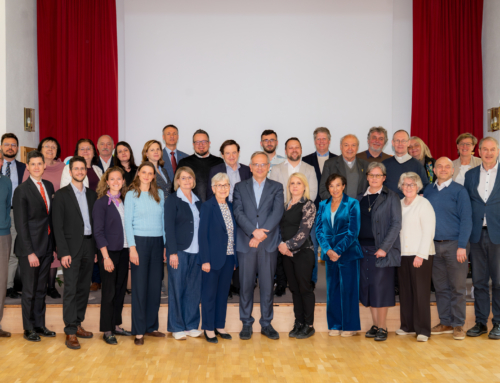
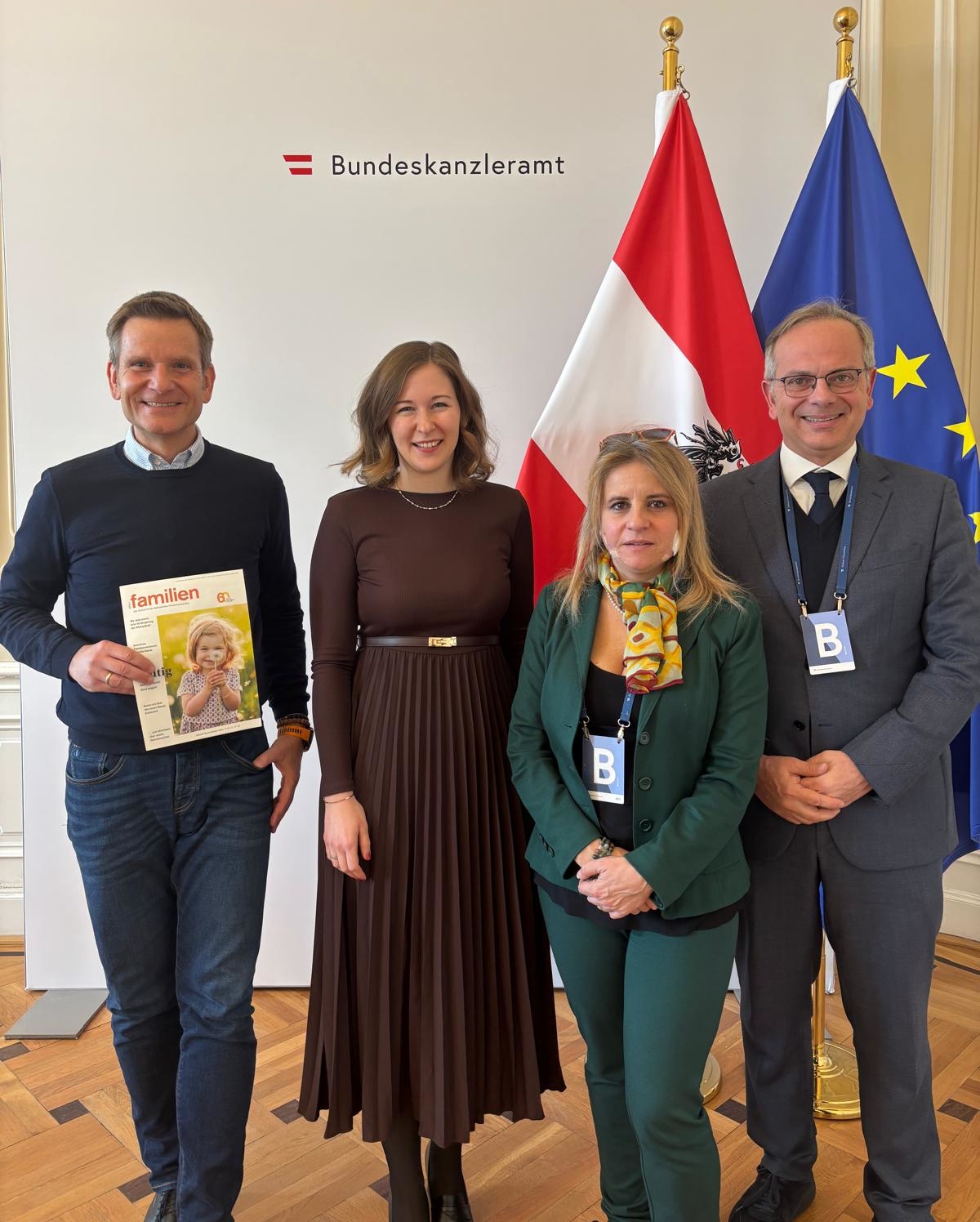
FAFCE president Vincenzo Bassi was invited this week by FAFCE’s member organisation in Austria the Katholischer Familenverband Österreich (KFÖ) to take part in a conference in Vienna. In addition, during his visit in Vienna, Vincenzo Bassi and his wife had a meeting together with the KFÖ president Peter Mender and the Austrian Federal Minister for Europe, Integration and Family in the Federal Chancellery, Claudia Bauer.
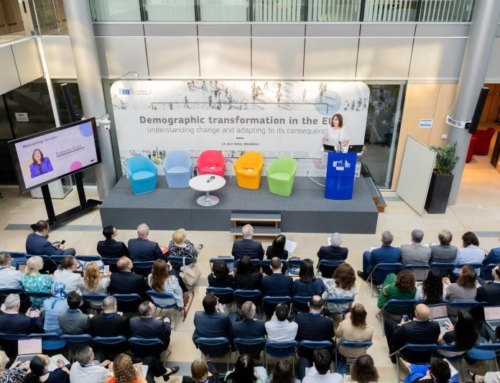
The event, titled “Family as a Project for the Future – In Dialogue on Demographic Change,” took place on 24 February 2026 in the Stephanisaal at Stephansplatz 3, 1010 Vienna. It was organised by the Institut für Ehe und Familie in cooperation with the Katholischer Familienverband Österreichs.
The starting point of the evening was the growing significance of demographic change, which is having a profound impact on Austria’s social, economic and cultural fabric. The day before, on 25 February, Statistik Austria published the birth figures for 2025, revealing a historic low. Only 75,718 children were born alive in Austria – 2.0% fewer than the previous year. The average number of children per woman fell to 1.29, an all-time low. For the sixth consecutive year, the birth balance remained negative, with 11,048 more deaths than births.
The aim of the evening was not merely to discuss the value of the family as a response to crisis, but rather to place the family at the centre as a lived space of relationship and hope.
The programme was divided into two parts: keynote impulses followed by a panel discussion.
Keynote contributions
Former Federal Minister and university professor Dr. Heinz Faßmann, President of the Austrian Academy of Sciences, provided a scientific assessment of the demographic situation. He noted that the fertility rate currently stands at 1.31 children per woman and that even a slight upward movement beyond the decimal point would already constitute progress. He emphasised that the parental generation is no longer being replaced by a generation of children and called on policymakers to take concrete measures: expanding childcare, increasing fathers’ participation in family life, and strengthening financial support for families.
Dr. Gudrun Kugler, Member of the Austrian Parliament and Vice-President of the OSCE Parlamentary Assembly, where she serves as Special Representative on Demographic Change and Security, turned attention to rising childlessness. She pointed out that not only are families having fewer children, but fewer people overall are taking the step into parenthood. Of those who remain childless, two thirds could in principle imagine having children but wait for the “right moment” – and what begins as a “not yet” can too often become a “unfortunately never.” Kugler, herself a mother of four, also called for greater societal recognition of the contribution parents make.
Vincenzo Bassi, President of FAFCE, delivered a passionate address urging that family policy be treated as a top political priority. He posed a provocative question: if billions spent on tanks and missiles are considered investments in the future, how much more should we regard resources allocated to families in the same light? “Without children, there is no future to defend”.
Mag. Barbara Haid, MSc, President of the Austrian Federal Association for Psychotherapy, stressed that healthy family life requires time in order to flourish. Her message to parents in the “rush hour” of life was clear: “You are good enough as parents.” She advocated for a slowing down of daily pressures and addressed the perfectionism that weighs heavily on many young families.
Clarissa and Bernhard Pohorec, parents of three children and expecting their fourth, shared their personal experience. For them, each child is a gift, even though life inevitably changes. Clarissa Pohorec called for greater recognition and genuine freedom of choice, particularly for parents who consciously opt for longer periods of parental leave.
Panel discussion
The subsequent panel discussion was moderated by Judith Tscheppe and included the speakers alongside MMag. Hermann Glettler, the Austrian Bishops’ Conference’s Bishop responsible for Marriage, Family and the Protection of Life. Bishop Glettler encouraged greater courage to embrace imperfection and urged that the family be understood primarily as a space of relationships rather than a system of provision.
The shared tenor of the evening was clear: a broader societal shift in mindset is needed – one that places greater value on parenthood and gives young people the confidence to choose to have children. Supporting rising birth rates is not a marginal issue, but central to the future of our society.
FAFCE is very grateful for the collaboration and friendship with one of its oldest members, the Austrian Member KFÖ and wishes to continue representing the voices of the catholic families in Austria in the international institutions.