Pornography
Much of the pornography currently produced and made available through the Internet stands in serious conflict with gender equality, tackling stereotypes, protection of vulnerable persons and the promotion of human rights. Harmful effects produced by the consumption and production of pornography have been documented. Pornography has been found to desensitize the consumer to sexual aggression, causing sexual aggression towards women, normalizing sexual assault, and also producing rape myths, all of which has serious consequences for any attempt to reach gender equality.The current legal reality is that there are very few effective regulations governing pornography either domestically in the European Parliament or Council of Europe region or internationally. We are trying to make awareness in this section of our site of this phenomenon in our today society which affects our families and our children.
FAFCE Secretary General speaks at Pontifical Council for the Family Conference on the Rights of the Family
A Conference on the Rights of the family was hosted by the Pontifical Council for the Family together with the Italian Union of Catholic Lawyers at the Urbaniana University in Rome on 19-21 September 2013.
Conference on the Rights of the Family, Strasbourg, 1st Oct 2013
CONFERENCE 1st October 2013 European Year of Citizens & 30th anniversary of the Charter of Rights of the Family of the Holy See The family, a subject of rights Venue: European Youth Centre Council of Europe
FAFCE’s Message on the occasion of the International Day of the Family 2013: Invest in the Family, Families are Europe’s wealth!
Families are the basic units of society, and a family has a value of its own. It is more than just the simple sum of its members. From an economic perspective the family
Sweden discriminates! Collective complaint against Sweden in favor of conscientious objection and respect for democratic procedures
Press Release - Brussels, 8 March 2013 Sweden lacks respect both for the fundamental freedom of conscience laid down by the European Convention on Human Rights and for the democratic proceedings of
Collective Complaint against Sweden based on lack of respect for right to protection of health and Non-Discrimination
The FAFCE has submitted a collective complaint against Sweden. The FAFCE argues that Sweden lacks respect for articles 11 (right to protection of health) and E (Non-Discrimination) of the European Social Charter. The complaint is part
“What would you wish for each child: a secure environment or a change of civilisation?” asks FAFCE President on BBC
On Sunday 10 February 2013 FAFCE's President Antoine Renard explained how and why marriage protects children's rights and why the issue of filiation is at the centre of the current debate on marriage
Same-sex marriage and adoption law – A brief analysis of the situation in France
The French government wants to extend marriage, adoption and medically assisted procreation to same sex unions, what is at stake? What is the law about? The legal proposal is considered by the Government as a
Press release | Same-sex marriage and adoption in France – A profound change of the nature of Marriage, Adoption and Filiation and an injustice for each citizen, is this what the French President understands as justice for the youth?
Paris, 12 January 2013 Same-sex marriage and adoption in France: A profound change of the nature of Marriage, Adoption and Filiation and an injustice for each citizen, is this what the French President understands
Press release | FAFCE greets the European Parliament’s vote in favour of Tonio Borg, a vote respectful of Fundamental Freedoms
FAFCE greets the European Parliament’s vote in favour of the nomination of the Maltese Commissioner Designate Tonio Borg for the Health and Consumer Protection portfolio. In a full hemicycle the vote took place

European Parliament recognises the importance of the family in Employment and social policies
On October 22nd, the European Parliament adopted a Resolution on “Employment and social policies of the Euro area 2020” which recognises the vital importance of families and offers specific improvements in four different areas, as described in following paragraphs.
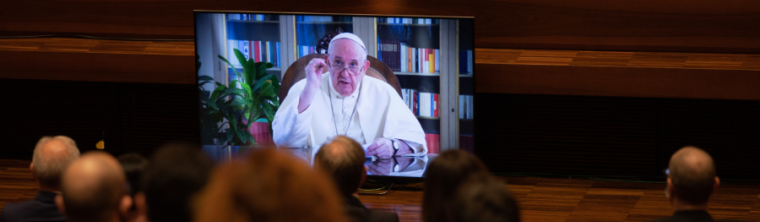
Pope Francis heartwarming message on education in times of pandemic
In these times of uncertainties and fear brought by the Covid-19 pandemic, Pope Francis brings a message of hope in his recent address on education. The Pope's video message was broadcasted during the Global Compact on Education at the

Slovakia: a bill under discussion to support pregnant women and young mothers
An amending proposal to the law on abortion is currently discussed in Slovakia, which proposes to improve pre- and post-natal care for women. The amended law would then offer new means to protect pregnant women and young mothers from

FAFCE participation to the Economic Forum (8-10 Sept 2020)
FAFCE participation to the 2020 Economic Forum FAFCE is happy to be this year again among the partners of the Economic Forum, that will be held on the 8-10 September 2020 in Karpacz (Poland). On the 9 September

Press Release | FAFCE’s President to EUCO Members: “Sustainable development only possible through demographic and family policies”
Brussels, 30 July 2020 Finding resources for family policies able to face the current demographic winter. This is the true challenge to make of the post-pandemic recovery a moment of regeneration for our Continent. This is the call made by the

FAFCE Newsletter | Happy Summer ☀️
Brussels, 15 June 2020 As the pandemic is slowly fading away, it is now time to reflect on these last months of the crisis and lockdown. This period saw a brutal halt of the world as we knew it.
