In order to improve the representation of family interests on a European level, catholic family organizations from various European countries have joined together in the Federation of Catholic Family Organizations in Europe
Welcome to the official website of the FAFCE
- Details
- Category: English
- Published on Tuesday, 03 May 2011 15:06
FAFCE's President addresses the European Commissioner in charge of Employment and Social Affairs
- Details
- Category: News
- Published on Tuesday, 21 May 2013 15:07
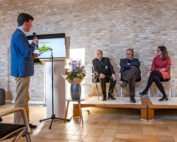
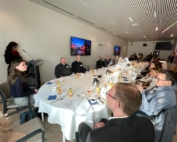
On 15 May, at the occasion of the International Day of the Family, the FAFCE co-organised a conference at the European Parliament on the topic 'Balancing Family Life and Work, Exploring the possibilities of a European family-friendly label'.
FAFCE's President Antoine Renard addressed a speech to Commissioner László Andor, inviting the European Commission to consider searching for new ways to help families in Europe find better balance between family life and work. The ideas presented by the FAFCE may be found in the speech quoted below.
"Commissioner, Ladies and Gentlemen,
As Commissioner László Andor pointed out at the opening of the 4th Demography Forum organised by the European Commission last week young Europeans have difficulties founding a family due to lack of jobs and lack of stable jobs. Today none of the EU Member States has a fertility rate that is high enough to renew the population, and despite the fact that there is a desire to have children European citizens do not have as many children as they wish.
This is a great problem because families are Europe’s wealth! Families are the basic units of society, a family is more than just the simple sum of its members, the family has a value of its own. From an economic perspective the family is not only a consumer but also produces riches.
To address this complex situation that is human, demographic and economic I wish to offer three ideas on how to exit this dead end road.
1. Full employment is essential for all families but we often hear that work and family life need to be reconciled. This expression indicates that there is a form of competition between work on the one hand, and family life on the other hand. I believe this approach is misleading. The FAFCE represents family associations from 15 Member States and in each of these countries families find it difficult to combine work and family life. Based on this fact, we would suggest to search for equilibrium and replace the word ‘conciliation’ by ‘balance’: families need work, employers need employees who have a harmonious family life, it is therefore in the interest of both parts to search for measures that help establish a balance between family life and work.
2. When designing working conditions we would suggest to put the family first, in other words create working conditions that take into account the needs of the family (time, resources, services). This can be done by family mainstreaming at every decision level.
3. Work is currently organized in a manner that corresponds to a model that has revolved: today both mothers and fathers are present in the labour market, but professional careers are organized as if one of them stayed full time at home. This organization does not correspond to the reality of how most European families live. This is why a life course perspective would be more adapted. It could rely on three aspects in particular:
- take into account the needs for maternal, paternal leaves, also at different ages of their children, not only for the newborns;
- value the invisible work done within the family and the competencies and capacities that this work develops;
- offer regular professional training to update the professional skills; this would also contribute to reduce the unemployment, and help to raise the average level of available competences.
To conclude: each of these points are in my opinion feasible and would greatly benefit from a deep dialogue between all stakeholders: families, employers, employee representatives, human resources experts, managers, and policy makers.
As President of the FAFCE, I wish to call on the European Commission to consider these proposals. It is my firm convictions that they would contribute to better balance for both families and employers. Our conference today is a first step in this direction, I hope it is not the last!"
FAFCE's Message on the occasion of the International Day of the Family 2013: Invest in the Family, Families are Europe’s wealth!
- Details
- Category: News
- Published on Tuesday, 21 May 2013 14:54
Families are the basic units of society, and a family has a value of its own. It is more than just the simple sum of its members. From an economic perspective the family is not only a consumer but also produces riches. In fact, families are Europe’s wealth!
As Europe is facing a deep and multiple crisis, with economic, demographic and foremost human costs, there is a huge pressure on each family. The family is the first place to which each one of us would turn for help and the solidarity within and between families, and across generations is an invaluable asset for our continent.
Austerity measures are necessary to contain and hopefully resolve the current crisis, every mother or father is aware of the need to make ends meet. However, the temptation to cut spending in the area of family policy and family friendly policies (taxation, balance between family life and work in the employment sector…) is a threat to every family.
Families need sufficient resources, therefore full employment is of utter importance. However, families also need balance between their family life and work. The experience and invisible work within the family are also an asset for employers, and should be rightly valued.
Families need time together, therefore flexible leave schedules for both mothers and fathers who care for their children or other family members in need are essential, just as common free time for each family, every week.
Families need sufficient and appropriate services, therefore family mainstreaming in both the public and private sector is necessary.
The FAFCE calls on the political decision makers in Europe to consider the priceless value that each family represents and to invest in the family through family policies and family friendly policies that consider the family as an ally of society!
Sweden discriminates! Collective complaint against Sweden in favor of conscientious objection and respect for democratic procedures
- Details
- Category: News
- Published on Thursday, 07 March 2013 21:41
Press Release - Brussels, 8 March 2013
Sweden lacks respect both for the fundamental freedom of conscience laid down by the European Convention on Human Rights and for the democratic proceedings of the Parliamentary Assembly of the Council of Europe. On 7 March the FAFCE filed a collective complaint against Sweden on the grounds of lack of respect for articles 11 (right to protection of health) and E (Non-Discrimination) of the European Social Charter.
On 7 October 2010 the Parliamentary Assembly of the Council of Europe adopted resolution (1763(2010)) The right to conscientious objection in lawful medical care, a text that invites member States to develop comprehensive and clear regulations that define and regulate conscientious objection with regard to health and medical services.
The Swedish Parliament voted its own initiative resolution against this text in May 2011, despite the fact that the resolution was adopted according to the democratic process that regulates all decisions taken at the Council of Europe. By not respecting this fundamental right for any citizen across Europe, Sweden actually breaches the very principles that are the foundation of the Council of Europe: Human Rights, Rule of Law and Democracy:
“The Report of Christine McCafferty, “Women’s access to lawful medical care: the problem of unregulated use of conscientious objection”, that preceded the Resolution 1763, caused a debate in Sweden about freedom of conscience for health care workers. The Swedish standing Committee has remained negative to the content of Resolution 1763 and the Swedish delegation has been directed by the Swedish Government to take action to accomplish a “change” of this resolution.
On 11 May, 2011, the Swedish Parliament debated the report, Resolution 1763 and its recommendations after a report from the Foreign Affairs Committee. The prospect that medical professionals and health care workers might exercise freedom of conscience initiated a debate. The Foreign Affairs Committee Report recommended that the Parliament should advise the Government to be “critical of the content of Resolution 1763” and consider “that the delegation should work to bring about a change in the nature of this resolution.” [1]The Left Party added a “reservation” suggesting that the Parliament ask for the abrogation of Resolution 1763. The Sweden Democrats, in contrast, expressed support for the Resolution in a separate reservation. The Swedish Parliament accepted the recommendation of the Foreign Affairs Committee. Sweden thus formally set itself against freedom of conscience for health care workers and against the goals of Article 11 of the European Social Charter.” (FAFCE’s collective complaint).
The Federation of Catholic Family Associations in Europe, FAFCE, a member of the INGO Conference of the Council of Europe and deeply attached to the values promoted by the latter has paid close attention since to the implementation of the resolution.
FAFCE’s President Antoine Renard stresses that “The right to conscientious objection is a safeguard for all of us, it provides a possibility for medical staff to enlighten their work by their conscience in relation to each one of their patients. The importance of conscience in the medical field grows every day as technology moves forward and medical staff is faced with ever more complicated decisions to make. Practising medicine is a human and moral activity, not just a technical one, as Hippocrates pointed this out centuries before our time.”
Considering that freedom of conscience is a fundamental right laid down by the European Convention on Human Rights and by the Charter of Fundamental Rights of the EU, and that its restriction is contrary to both these legal instruments and to the jurisprudence of the European Court of Human Rights, the FAFCE has been very concerned with Sweden’s lack of respect for the principles set forth by the resolution, which have still not been implemented there.
Mr Renard explains that this is why the FAFCE has filed a collective complaint against Sweden: “We hope that our collective complaint against Sweden will raise international awareness of this lack of respect for the democratic procedure and for the fundamental right to freedom of conscience, there is no reason that Swedish medical staff should be deprived of a right laid down by several European human rights instruments”.
Contact: Maria Hildingsson +32 4 70 20 39 18 or This email address is being protected from spambots. You need JavaScript enabled to view it.
__________________________________
[1] 2009/10:UU15 and 2011/12:KU14 http://www.riksdagen.se/sv/Dokument-Lagar/Utskottens-dokument/Betankanden/Fri--och-rattigheter_GZ01KU14/
Collective Complaint against Sweden based on lack of respect for right to protection of health and Non-Discrimination
- Details
- Category: News
- Published on Thursday, 07 March 2013 10:30
The FAFCE has submitted a collective complaint against Sweden. The FAFCE argues that Sweden lacks respect for articles 11 (right to protection of health) and E (Non-Discrimination) of the European Social Charter.
The complaint is part of the procedure foreseen by the Additional Protocol to the European Social Charter. FAFCE's complaint can be found here.
More Articles...
- The FAFCE calls for better protection of child victims of human trafficking - a collective complaint against Ireland
- "What would you wish for each child: a secure environment or a change of civilisation?" asks FAFCE President on BBC
- Same-sex marriage and adoption in France - A profound change of the nature of Marriage, Adoption and Filiation and an injustice for each citizen, is this what the French President understands as justice for the youth?
- The European Parliament votes on the nomination of maltese Commissioner Designate Tonio Borg: the FAFCE calls on MEPs to stand up for Fundamental Freedoms