Pornography
Much of the pornography currently produced and made available through the Internet stands in serious conflict with gender equality, tackling stereotypes, protection of vulnerable persons and the promotion of human rights. Harmful effects produced by the consumption and production of pornography have been documented. Pornography has been found to desensitize the consumer to sexual aggression, causing sexual aggression towards women, normalizing sexual assault, and also producing rape myths, all of which has serious consequences for any attempt to reach gender equality.The current legal reality is that there are very few effective regulations governing pornography either domestically in the European Parliament or Council of Europe region or internationally. We are trying to make awareness in this section of our site of this phenomenon in our today society which affects our families and our children.

A new European Citizens’ Initiative in favour of Marriage and Family
On 11 December the European Commission gave its green light to start a new European Citizens' Initiative (ECI) in favour of marriage and family called Mum, Dad & Kids. The initiative asks the

Press Release | Surrogacy Motherhood debated at the Council of Europe – are Human beings a commodity?
Human beings, a commodity? Surrogacy Motherhood leads to commercialisation of women and children, prices for Surrogacy Motherhood can range from 76,000 to 171,000 US $. Brussels, 18 November 2015 On Monday 23 November the Committee
Press Release | EP Interest Group on Work-Life Balance Meets
EP Interest Group on Work-Life Balance Meets: Healthy work places in Europe, keys to preventing psychosocial risks Brussels, 11 December 2015 Tackling the rise in psychosocial diseases by ensuring a fair work-life balance, proper

Stakes for the Post-2015 Global Development Agenda
Marguerite A. Peeters* Original title, in French: Enjeux de l’Agenda de Développement Mondial de l’Après-2015, Liberté politique n. 67, Paris, Autumn 2015 (www.libertepolitique.fr). FAFCE thanks the Author and the Publisher for giving the authorisation for its online publication and

FAFCE crosses the Atlantic
In September and October FAFCE was present at three events across the Atlantic : the World Meeting of Families in Philadelphia, USA, a Congress for a Culture of Life and Family in Bogotá, Colombia, and
Cooperating for Human Dignity
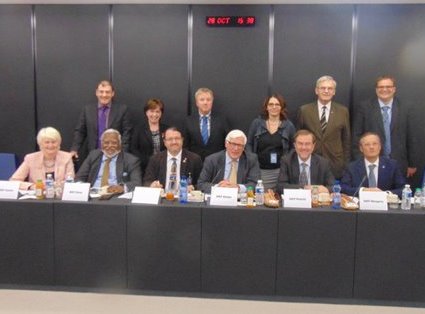
Relaunch of the Human Dignity Working Group “The infinite dignity of every human being is routinely denied across all stages of life, from conception until natural death. Therefore, the concept of human dignity
FAFCE received EU Family Values Award!
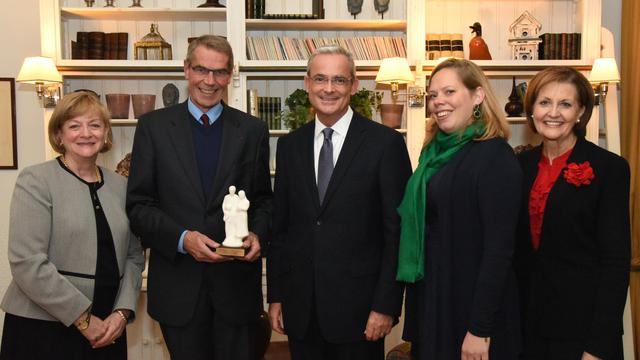
At a celebration held in Brussels on 19 October 2015, the Federation of Catholic Family Associations in Europe (FAFCE) received the EU Family Values Award by The Church of Jesus Christ of Latter-day
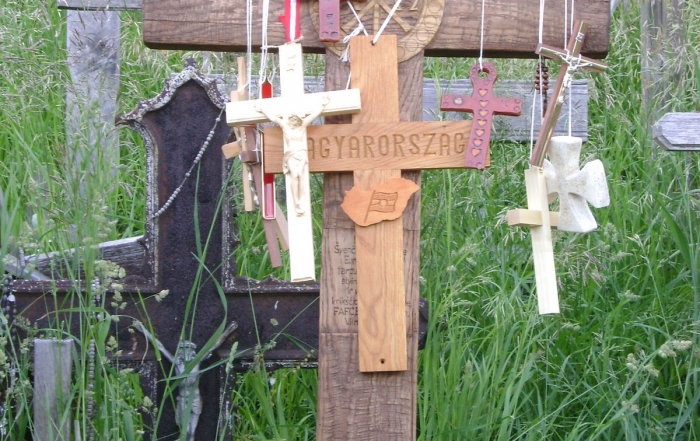
Press release | Every family can help a fleeing family
This cross was put on the Hill of Crosses in Lithuania in 2009 by representatives of FAFCE and its Members for all Christian families in Europe Brussels, 10 September 2015 Many doors to homes, parishes

The President of the European Council is clear : “The definitions of marriage and family are matters of national competence for EU Member States”. What about the European Commission?
On 23 July FAFCE President, Antoine Renard, wrote a letter to the President of the European Council, Donald Tusk, in order to express the concerns of the European Federation of Catholic Family Associations

FAFCE adopts the logo of the Amoris Laetitia Family Year!
31 March 2021, On 19 March 2021, Solemnity of St. Joseph, the Church celebratedthe fifth year of the publication of the Apostolic Exhortation Amoris Laetitia on the beauty and joy of love in the family. On the same day,

EU Strategy on the Rights of the Child & European Child Guarantee: the European Commission acknowledges the role of parents and families
30 March 2021 On the 24th of March 2021, the European Commission published the EU Strategy on the Rights of the Child and proposed a Council recommendation on a European Child Guarantee. The two documents aim to offer a

EU Budget 2022: The European Parliament emphasises the need for demographic and family policies
29 March 2021, Last week, the European Parliament adopted a resolution on "Guidelines for the 2022 Budget - Section III" (Rapporteur: Karlo Ressler, EPP, Croatia), which calls for the inclusion of demographic and family policies in the

Portuguese Constitutional Court Rules Against the Legalisation of Euthanasia
22 March 2021, The debates on the legalisation of euthanasia continue in Portugal. For now, Portugal does not seem to follow the path of Belgium, the Netherlands, Luxembourg and, most recently, Spain, the four European countries who permit euthanasia.

Decreasing birth rates in Europe: is it really the choice of parents?
Brussels, 10 March 2021 Europe faces a clear pattern of decreasing birth rates over the past decades. In 2018, the average number of childbirths in the EU was 1.55 per woman. It is, as stated by the European Commission

Vision and commitment of FAFCE against pornography: interview for the Italian association PURIdiCUORE
Brussels, 3 March 2021 On 18 February 2021, Bénédicte Colin, FAFCE Project Manager, shared the work of FAFCE against pornography with the Italian association PURIdiCUORE, also dedicated to tackle the challenges of pornography. The association promotes the integrity in
