Brussels, 11th of June 2026
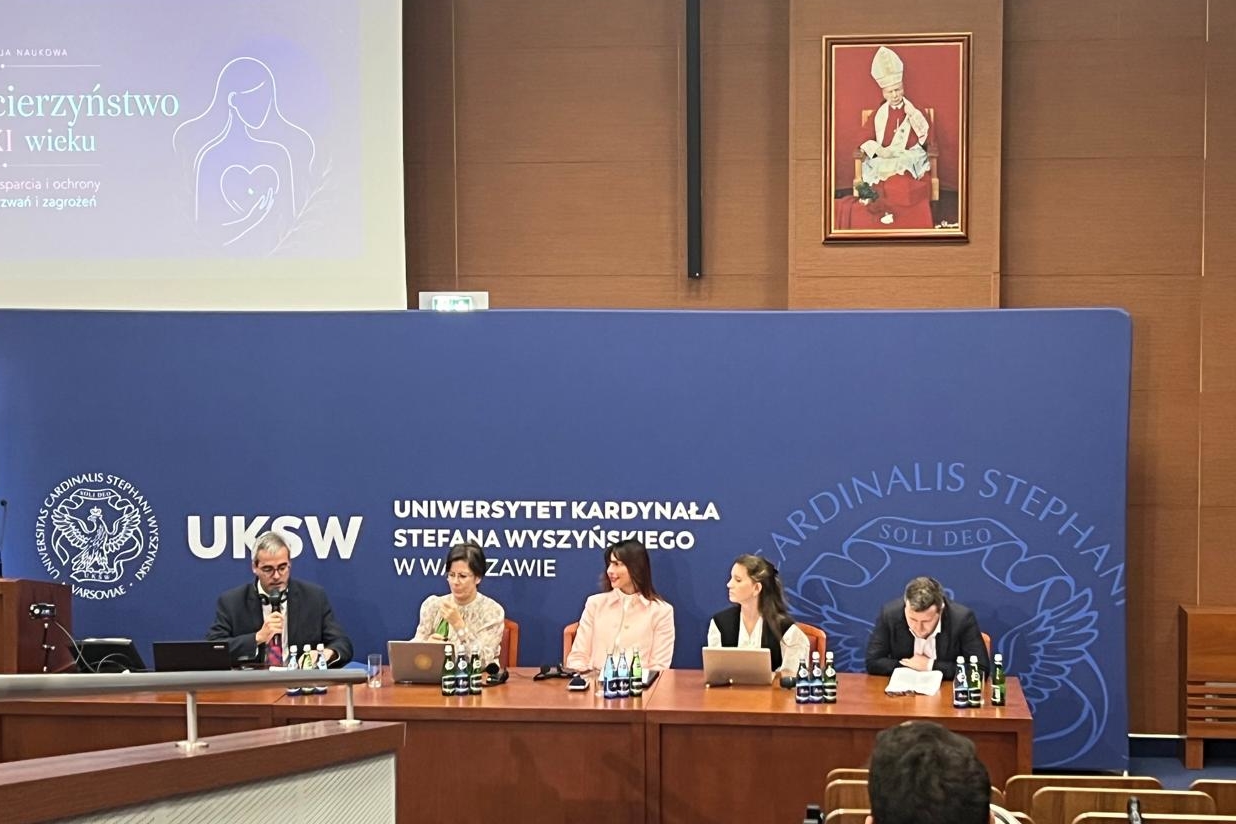
Last week, on the 3rd of June, FAFCE took part in the conference “Motherhood in the 21st Century – Support and Protection Policies in the Face of Challenges and Threats”. This event, organised in Warsaw, aimed at providing a platform for an in-depth, interdisciplinary debate bringing together politicians, academics, lawyers, and representatives of non-governmental organizations from Poland and abroad. A special focus was placed on surrogacy, including its legal, psychological and ethical dimensions.
The first panel focused on “Motherhood and Parenthood under the Protection of the Republic of Poland”. Speakers presented effective models of support for families and mothers. FAFCE was particularly happy to hear Polish MEP Marlena Maląg (ECR, former Minister of Family and Social Policy), say that “family policies should be considered investment, not a cost” and “that it is up to parents to decide on how they want to raise their children”. Karina Bosak, lawyer, Member of the Sejm of the Republic of Poland, reminded that motherhood is not a private matter – it is also Common good and that a strong state is built by strong families and strong social bonds. Her speech was followed by a presentation from Rafał Dorosiński, member of the Family and Demography Council at the President of the Republic of Poland, who pointed out that the system very often values motherhood less than work outside of home: enhancing women to come back to the labour market earlier by benefits sends a clear message. Michał Kot, member of the Family and Demography Council at the President of the Republic of Poland, offered a refreshing perspective on the topic of demographic crisis and, at the same time, a very accurate analysis on the socio- cultural reasons of postponing motherhood. He stated that if being a parent was considered prestigious, more people would have children and suggested that allocating money in policies that truly recognise the value of mothers, ensuring that families are present and welcome in the public sphere and paying attention to the language we use when speaking about children could redirect society’s respect from economic status or career towards having a family.
The second panel brought attention to the practice of surrogacy and the experience of motherhood. Speakers presented legal, psychological, and ethical aspects. Reem Alsalem, the United Nations Special Rapporteur on violence against women and girls, brought attention to the abusive and violent exploitation of women, often coming from poorer backgrounds, who become surrogate mothers, predominantly because of extreme financial needs. She brought attention to the cruelty of contracts, the imbalance of power between surrogate mothers and parents/clinics (main profiteers from this industry), the economic violence the surrogate mothers are subjected to and the physical and psychological harm. She also pointed out that the demand would not be so big, if it weren’t for the commodification of women’s bodies and called for the abolitionist approach while recognising that “legalising and regulating the practice will only increase the feeling that we can commodify bodies and shop for children”.
Olivia Maurel, spokesperson for the Casablanca Declaration focused on the child’s perspective. Born through surrogacy, she spoke about the fear of rejections and feeling of abandonment through years resulting from the deliberately organised rupture of the link between her and biological mother, as if she was “programmed to be abandoned“. She regretted that the conversation revolves around adults, their desires and needs, when it should revolve around the child, as “a child is a person not a product”. She reminded that there is no international law to have a child, but children have a right to identity and knowing where they come from and that surrogacy is making someone’s abandonment a price for someone’s happiness. She called to “protect children at all cost and not treat them as mere commodities”.
Bettina Roska, lawyer at ADF International gave an insight on the international legal framework and highlighted that while surrogacy involves human trafficking and is incompatible with the best interest of the child principle, regulations and guidelines create an illusion of ‘ethical’ surrogacy and therefore legitimise the process.
Calum Miller, physician and researcher at the University of Oxford spoke about medical and ethical considerations. He provided studies showing that the relationship of a baby with their mother is irreplaceable, and that rupturing it causes profound consequences for the mother and the child.
The last panel was titled “Cultural Affirmation of Motherhood: Diagnosis and Strategies for Positive Change“. Ewa Rejman (lawyer, LL.M. in International Law and Human Rights) reminded that mothers cannot be left alone, as while society needs mothers, they need a society too. Anna Bosak, President of the Fundacja Priorytety, spoke about building a positive image of motherhood: “motherhood needs recognition not embellishing”. Jadwiga Wiśniewska, Member of the European Parliament (ECR), presented the EU perspective (particularly her experience in the FEMM committee and highlighted the importance of family mainstreaming in the EU institutions.
FAFCE has long been working on the issue of maternal mobbing, calling to recognise the value of unpaid care work done in families. FAFCE is also proud to be part of Casablanca Declaration, the coalition committed to the universal abolition of surrogacy. We thank the organisers, speakers and attendees supporting this cause, crucial for human dignity.
More on FAFCE work on the maternal mobbing:
FAFCE-NWFE White Paper on “Protecting women from maternal mobbing”
More on FAFCE work on surrogacy: